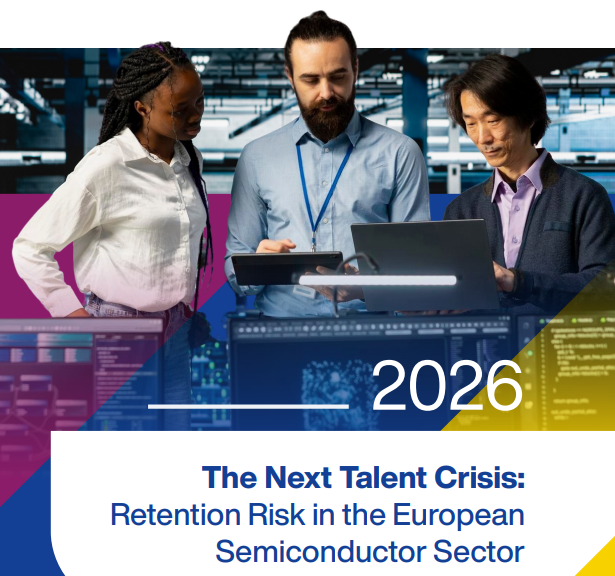
Europe’s semiconductor industry is preparing for a major generational change. Around 114,000 employees are expected to retire by 2030, while the number of new graduates entering relevant fields is growing by only around 1% a year. A new report from the European Chips Diversity Alliance (ECDA) highlights another dimension of the challenge: Europe must not only attract new semiconductor talent, but also become better at retaining the people already working in the sector.
The ECDA DEI Report 2026 – The Next Talent Crisis: Retention Risk in the European Semiconductor Sector is the Alliance’s largest study to date examining why technical professionals stay in or leave Europe’s semiconductor industry. It draws on responses from 220 technical workers across 15 European countries, complemented by interviews with HR professionals in Germany and France and representatives of national semiconductor organisations in Spain and Ireland.
Its findings suggest that the retention challenge is already significant: 26% of technical workers surveyed expect to leave their current employer within the next three years. Against the backdrop of an ageing workforce and an already constrained talent pipeline, losing experienced people unnecessarily could further increase pressure on European companies.
Fair career progression matters more than expected
One of the report’s most striking findings concerns the reasons why employees consider leaving.
Although higher pay is among the things employees most frequently say they want, salary itself was not the strongest predictor of whether someone intended to leave. Instead, the clearest signal was whether employees regarded career progression within their organisation as fair.
Workers who considered progression processes unfair were nearly two and a half times more likely to be planning their departure.
This shifts part of the retention discussion from compensation towards organisational culture and transparency. Clear criteria for career development, understandable progression paths and confidence that opportunities are allocated fairly can therefore have a direct impact on whether technical specialists decide to stay.
The report consequently recommends measures including transparent career progression frameworks and greater attention to fairness during the mid-career period, when employees’ trust in progression opportunities can begin to decline.
Younger professionals may want expertise rather than titles
The generational findings are equally noteworthy. Younger technical professionals were found to be leaving organisations at roughly twice the rate of Generation X employees. Yet the data does not suggest that younger workers receive less support. In fact, they reported some of the strongest levels of organisational support. The difference appears to lie partly in how they understand professional growth.

Rather than focusing primarily on promotion or management titles, many younger engineers place greater value on opportunities to deepen their technical expertise, learn and develop new capabilities.
For a highly specialised industry such as semiconductors, this is an important message. Career development does not necessarily have to mean moving from engineering into management. Strong technical career paths, continued professional education, mentoring and access to challenging projects can be equally important retention tools.
High pressure alone is not what makes people leave
Another finding challenges a common assumption about demanding technology sectors. High workload and workplace pressure were experienced by both employees who intended to stay and those considering leaving. Workload itself was not a significant predictor of departure.
What differentiated the two groups much more strongly was whether people felt supported, listened to and that they belonged within their organisation.

This does not mean that workload or work–life balance are unimportant. Rather, the findings suggest that demanding work becomes considerably more sustainable when employees experience supportive management, fair treatment and a sense that their contribution is recognised.
Retention is part of Europe’s semiconductor competitiveness
The findings arrive at a critical time for the European semiconductor ecosystem. Europe is investing heavily in new research infrastructure, pilot lines, production capacity, chip design and skills development. Yet physical infrastructure alone cannot strengthen the ecosystem without enough people to operate it, develop new technologies and transfer highly specialised knowledge.
The new ECDA report therefore adds another important element to Europe’s skills debate. Recruiting more students and graduates remains essential, but retention must become part of the same strategy.
Transparent career paths, opportunities for continuous technical development, inclusive workplace cultures and supportive leadership are not simply HR topics. In a sector facing large-scale retirements and a limited supply of new specialists, they are becoming factors in Europe’s ability to maintain and expand its semiconductor capabilities.

The message from the report is therefore encouraging as well as urgent: employee turnover is not simply an unavoidable feature of a competitive labour market. Many of the factors associated with retention can be addressed by organisations themselves.
For Europe’s semiconductor sector, keeping existing expertise may ultimately prove just as important as finding the next generation of talent.
Read the full ECDA DEI Report 2026: The Next Talent Crisis: Retention Risk in the European Semiconductor Sector.