Artificial intelligence may be transforming the world through software, but behind every AI application lies sophisticated semiconductor hardware. As a main partner of AI Days 2026, the Czech Republic’s largest nationwide AI festival, the Czech Semiconductor Centre (CSC) is highlighting the crucial role of chips, computing power and energy efficiency in the AI revolution. Visitors can meet CSC representatives at two major events in Brno and Prague this November.
From 2 to 15 November 2026, the fifth edition of AI Days will bring together researchers, businesses, technology enthusiasts and the general public across all 14 regions of Czechia. The festival explores how artificial intelligence is already changing industries, workplaces and everyday life. Last year’s edition attracted more than 14,000 participants, with 243 events organised in 35 cities.
This year, CSC is joining the festival as a main partner to draw attention to an essential but often overlooked dimension of artificial intelligence: the semiconductor technologies that make AI possible.
AI needs more than algorithms
The rapid growth of artificial intelligence is driving unprecedented demand for computing power. Every interaction with a chatbot, every AI-generated image and every advanced machine-learning application relies on processors and other semiconductor components performing complex calculations.
As AI systems become increasingly sophisticated, their energy consumption is also becoming a major challenge. Developing faster, more efficient chips is therefore essential to making AI technologies more powerful, affordable and sustainable.
“When people talk about artificial intelligence, most imagine software. Few realise, however, that behind every response from ChatGPT or any other AI system lies a huge amount of semiconductors and electricity. One exaFLOPS – the level of performance achieved today by larger AI computing clusters – already equates to roughly one megawatt of power consumption. That is equivalent to the power generated by more than six thousand cyclists pedalling at full speed. Globally, data centres consume tens of gigawatts, and their energy requirements are growing rapidly. This is precisely why modern semiconductors, which help to use energy as efficiently as possible, are becoming increasingly important. Experts in Brno and other parts of the Czech Republic also play a significant role in their development and manufacture. We want to show that AI is not just software, but also a fascinating world of electronics, energy and semiconductors, in which one can study and build a promising career,” says Petr Kamenický, director of the Czech Semiconductor Centre.
2 November, Brno: What makes machines think?
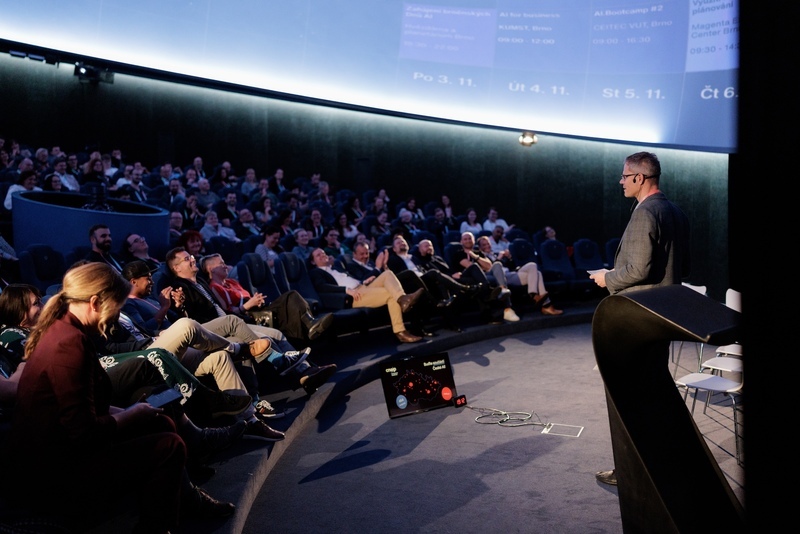
The opening of the Brno programme will take place at the Brno Observatory and Planetarium, bringing together experts from the fields of artificial intelligence, semiconductors and robotics.
One of the speakers will be Karel Masařík, representing Czech Semiconductor Centre and onsemi, who will explore the relationship between AI computing power, semiconductor hardware and energy consumption.
His presentation will address a fundamental question: how can we continue increasing computational performance while keeping energy demand under control?
The programme will also feature Jan Černocký from Brno University of Technology, who will explain the latest developments in generative AI, alongside robotics experts Martin Krček from Sentio Robotix and Stanislav Věchet from BUT.
Visitors can look forward to short expert presentations, a panel discussion on AI entering the physical world, live robotics demonstrations, a technology exhibition and networking with representatives of Brno’s innovation ecosystem.
Event programme and registration
10 November, Prague: Turning AI research into real-world innovation
CSC will also be present at the Young AI Research Forum: From Research to Impact, hosted at the Czech Institute of Informatics, Robotics and Cybernetics (CIIRC) of the Czech Technical University in Prague. The event will focus on a challenge shared by both the AI and semiconductor sectors: how to transform excellent academic research into technologies, products and successful businesses.
Designed primarily for young researchers, PhD students and emerging technology entrepreneurs, the forum will explore industry collaboration, access to advanced computing infrastructure, technology transfer, spin-offs and investment opportunities.
An expert panel discussing career paths beyond academic research will feature Veronika Štěpánková, start-up consultant at JIC, one of CSC’s consortium partners, alongside Jan Kořenek from Brno University of Technology and DynaNIC, a Czech technology company developing FPGA-based hardware acceleration solutions. Sintija Meissner, Head of Technology Transfer and Fundraising at CTU, will also join the discussion.
DynaNIC represents an example of how Czech academic research can develop into a deep-tech business addressing the growing demands of AI computing and high-speed data processing. The forum will also offer research pitches, poster presentations, thematic discussion tables and networking opportunities, creating valuable connections between academia, startups and industry.
Event programme and free registration
Connecting the AI and semiconductor ecosystems
CSC’s involvement in AI Days reflects its wider mission to connect semiconductor expertise with emerging technological needs. As Czechia’s national Chips Competence Centre, CSC supports companies, startups, research institutions and students in accessing semiconductor expertise, European infrastructure and innovation opportunities.
Artificial intelligence and semiconductor technologies are increasingly interdependent. Advances in AI create new requirements for chip performance and efficiency, while advances in semiconductor technology enable new generations of AI applications. We look forward to meeting researchers, entrepreneurs, students and technology enthusiasts at AI Days 2026!
Explore the complete festival programme at www.dny.ai.