CzechInvest, in cooperation with the Supply Chain Resilience Center at the Faculty of Science, Charles University, has published an important study entitled Value Chain Analysis in the Semiconductor Industry. The analysis, prepared by Brian Havlín from CzechInvest together with Zuzana Holická and Jiří Blažek from the Supply Chain Resilience Center, provides one of the most comprehensive mappings to date of Czechia’s semiconductor ecosystem and its position within European and global production networks.
The publication comes at a time when semiconductors are no longer viewed solely as components of electronic devices, but as strategic assets. As the analysis states, semiconductors are a “key technology of the 21st century” and their availability can fundamentally affect the economic and national security of individual states. This perspective is particularly relevant for Europe, which remains dependent on semiconductor imports from Asia and the United States, while seeking to strengthen its own production, research and technological sovereignty.
The study underlines that the global semiconductor industry is characterised by a high degree of specialisation and a wide geographical distribution of production stages. This fragmentation has increased efficiency, but it has also exposed the entire system to risks linked to geopolitical tensions, trade restrictions, export controls, supply disruptions, cyber security and climate-related pressures. The concentration of production in a limited number of countries, especially in Asia, creates vulnerabilities that can have global consequences. According to the analysis, the Asia-Pacific region accounted for 70.1% of the global semiconductor market value in 2023, while the United States accounted for 18.2% and Europe for only 7.1%.
This makes the European context particularly important. The analysis notes that the European Union is a net importer of transistors, diodes and integrated circuits, with a significant share of imports coming from China and Taiwan. At the same time, Europe retains a strong position in selected parts of the value chain, especially in semiconductor manufacturing machinery and materials. European companies hold a 27% share of the global machinery market and a 33% share of the materials market. However, Europe’s position is significantly weaker in chip manufacturing and fabless chip design, where Taiwanese, South Korean and US companies dominate.

Against this background, Czechia occupies a specific and strategically relevant position. The country is not a semiconductor superpower in terms of market share, but it has a combination of industrial tradition, technical expertise, research capacity and specialised companies that gives it a meaningful role in strengthening the European semiconductor ecosystem. The analysis recalls Czechia’s long history in semiconductor manufacturing, dating back to the second half of the 20th century and associated with companies such as Tesla, especially the production base in Rožnov pod Radhoštěm. This historical foundation has been transformed into today’s ecosystem of domestic firms, foreign investors, research organisations and suppliers.
The current Czech semiconductor components market is estimated at approximately EUR 1.97 billion in 2024 and is expected to grow to around EUR 2.97 billion by 2029, representing an average annual growth rate of 8.51%. The sector employs around 6,000 people in Czechia and generates revenues of CZK 33.66 billion. Although Czechia’s estimated share of the EU market is only 0.7%, which is below the country’s economic weight within the EU, the analysis shows that Czechia is relevant in several high-value segments.
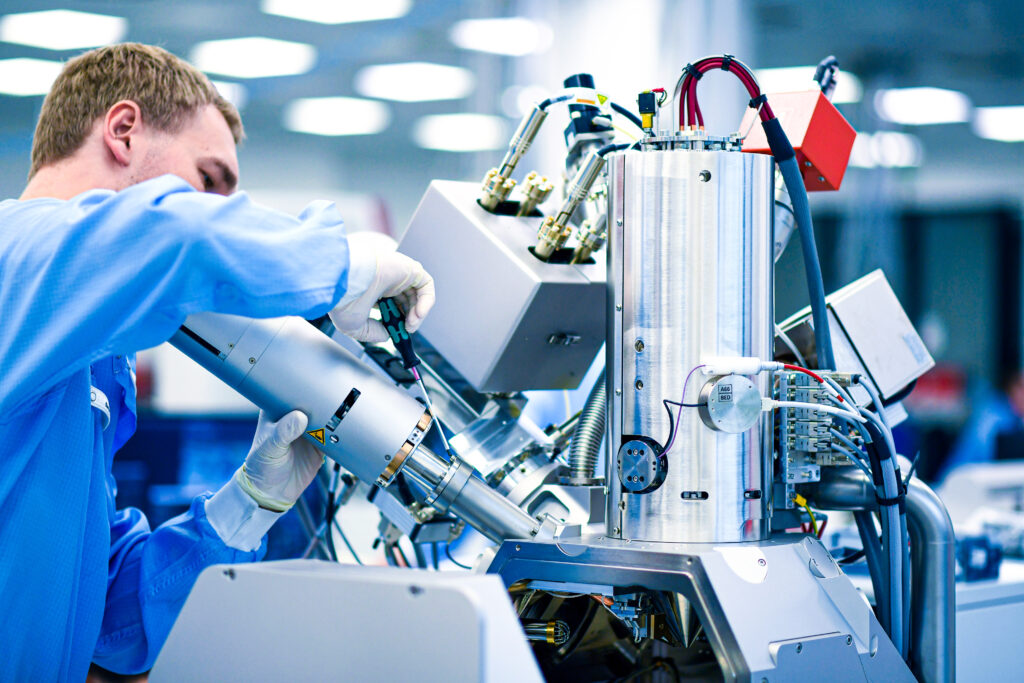
The Czech semiconductor industry is particularly strong in the supply of machinery and equipment for the production of integrated circuits, including electron microscopes, optical components and specialised machinery. Czech companies are also involved in the construction of factories, cleanrooms, liquid and gas distribution systems and other facility infrastructure. In addition, the country has capabilities in integrated circuit design, including analogue and digital circuits and ASIC chips, as well as production of analogue integrated circuits and discrete components.
The mapping identified 121 companies involved in the semiconductor industry in Czechia. Roughly two-thirds of them, 78 companies, are directly involved in the semiconductor supply chain, while the remaining 43 are significant users of semiconductor products. The most represented segments include facilities, equipment and machinery, parts and components, and chip design. This structure is important: Czechia’s strength lies less in mass chip fabrication and more in specialised inputs, enabling technologies and engineering-intensive segments that support semiconductor production globally.
The analysis also shows a strong research and development dimension. In 2023, 75 companies from the mapped sample were registered as conducting R&D, almost double the number in 2010, while R&D expenditure almost tripled over the period. This confirms that innovation is not peripheral but central to the Czech semiconductor ecosystem. The importance of universities and research organisations is also evident, including activities at Brno University of Technology, CTU in Prague, Masaryk University and institutes of the Czech Academy of Sciences, particularly in areas such as chip design, electron microscopy, electron lithography and wafer metrology.
Foreign direct investment has played a substantial role in the development of the sector. Since 2003, 12 semiconductor-related investment projects have been implemented in Czechia, creating 2,652 jobs and bringing total capital investment of approximately USD 2.388 billion. The largest investment identified in the analysis was made by onsemi in Rožnov pod Radhoštěm, where the company expanded production capacity for silicon carbide semiconductor wafers. This is especially significant because silicon carbide is essential for power electronics, electric mobility, energy systems and other fast-growing applications.
The study’s SWOT analysis identifies several key strengths: geographical proximity to major chip hubs in Europe, a tradition of semiconductor component manufacturing, developed research, development and manufacturing in power electronics, integrated circuit design, electron and ion microscopes, optoelectronics, radiation-hardened electronics and software tools, as well as a developed electron microscopy sector. These strengths position Czechia as a relevant contributor to Europe’s ambition to increase resilience and reduce strategic dependencies.
At the same time, the analysis is clear about weaknesses and risks. These include shortages of skilled people in both the education system and labour market, insufficient funding for higher education, an insufficiently innovative environment and a negatively perceived migration policy. Threats include declining ability to attract technology investment, loss of human capital abroad, subsidy competition from other jurisdictions, supply chain disruptions and potential loss of competitiveness due to illegitimate transfers of intellectual property or the presence of high-risk entities.
The strategic significance of Czechia therefore lies in targeted specialisation. The country is unlikely to compete with Asia or the United States in the largest and most capital-intensive areas of semiconductor manufacturing. Its opportunity is to build on areas where it already has proven strengths: power electronics, advanced machinery, electron microscopy, specialised components, facility infrastructure and chip design. In these segments, Czechia can support the resilience of European supply chains while remaining connected to global production networks.
The analysis concludes that the Czech semiconductor industry has “great potential to contribute to European efforts to strengthen global competitiveness and self-sufficiency” in this strategic sector. This potential depends on further expansion of global semiconductor companies located in Czechia, but also on the ability of Czech companies to deepen their presence in important global value chain segments. The essential prerequisite will be stronger cooperation between research organisations, universities and private companies, both domestically and internationally, especially within the EU.
CzechInvest’s analysis is therefore more than a sectoral mapping exercise. It is a strategic document showing where Czechia already creates value, where its vulnerabilities lie and how public support, investment and research cooperation can be targeted more effectively. In a sector that increasingly defines technological sovereignty, economic security and industrial competitiveness, Czechia’s role is not marginal. It is specialised, highly interconnected and strategically important for Europe’s semiconductor future.
Read full document here: Value Chain Analysis in the Semiconductor Industry_ENG
Photos: onsemi & Brno Tech Region Toolbox