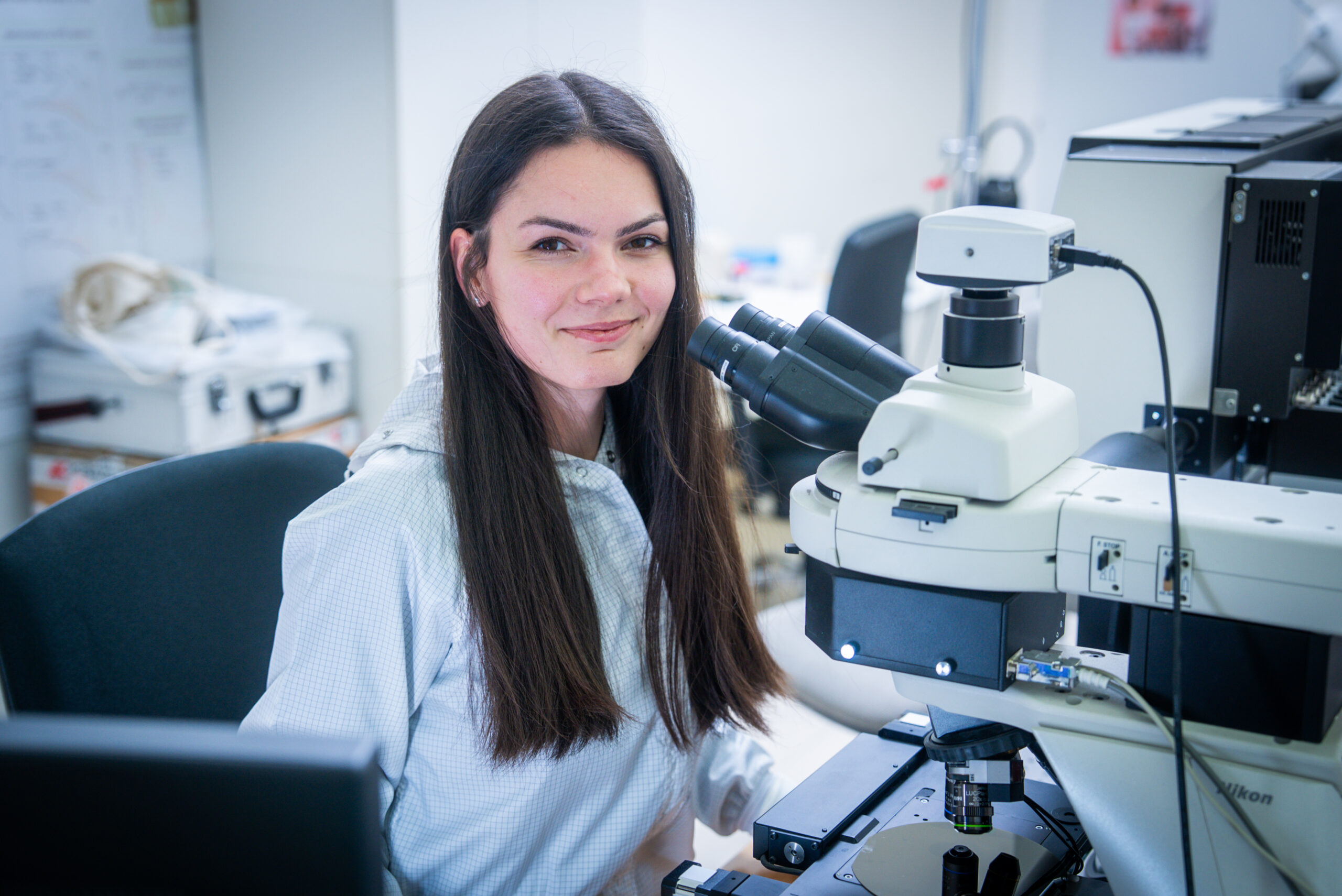
Success doesn’t happen by chance—and that’s doubly true for Helena Fojtášková. Even when she was choosing her major at the Faculty of Chemistry at Brno University of Technology, she knew exactly what she wanted: to focus on materials. Chemistry fascinated her, and she knew that it held the key to the innovations shaping the future. Today, she works at onsemi as a product engineer, dealing with defects in semiconductor materials, among other things. In this article, she reveals how she went from a student internship to a job at onsemi in Rožnov.
“If someone had told me when I was younger that I’d be working at onsemi, I wouldn’t have believed it,” Helena recalls. She hadn’t even considered the prestigious technology company back then, but life eventually led her right here—and not just because it’s based in her hometown of Rožnov pod Radhoštěm. In her second year of the Chemistry and Materials Technology program, she was offered an internship opportunity, and after a friendly interview, she found herself right in the thick of things. What was supposed to be a short internship ended up lasting until the end of her fifth year.
Today she knows that technical knowledge alone isn’t enough for success. “You have to constantly learn and push yourself forward. In addition to expertise, communication and teamwork are also key,” says Helena, noting that it was precisely these skills that helped her fit into the team and grow not only professionally but also personally.
onsemi is a technology leader specializing in the development and production of semiconductors and chips. During her internship, Helena focused on studying defects in single crystals, an area critical to the production of high-quality semiconductor components. Her work involved examining these defects—their form, origin, and impact on component functionality. “The size of these defects ranges from the atomic level to several hundred micrometers. If we manufacture a component with a critical defect, it simply won’t work or its reliability will be reduced. Our goal is therefore to produce substrates with as few defects as possible. Defects in the material are, among other things, my daily focus in my current work,” Helena explains.
Silicon is no longer the sole king of semiconductors. 4H-SiC is taking its place—a material revolutionizing electronics thanks to its superior physical and electrical properties. “It’s an amazing material, but it also has its pitfalls,” says Helena. Her research focuses on reducing the defect density of this material and optimizing manufacturing processes. In other words, she is looking for a way to ensure that the chips of the future are even more reliable.
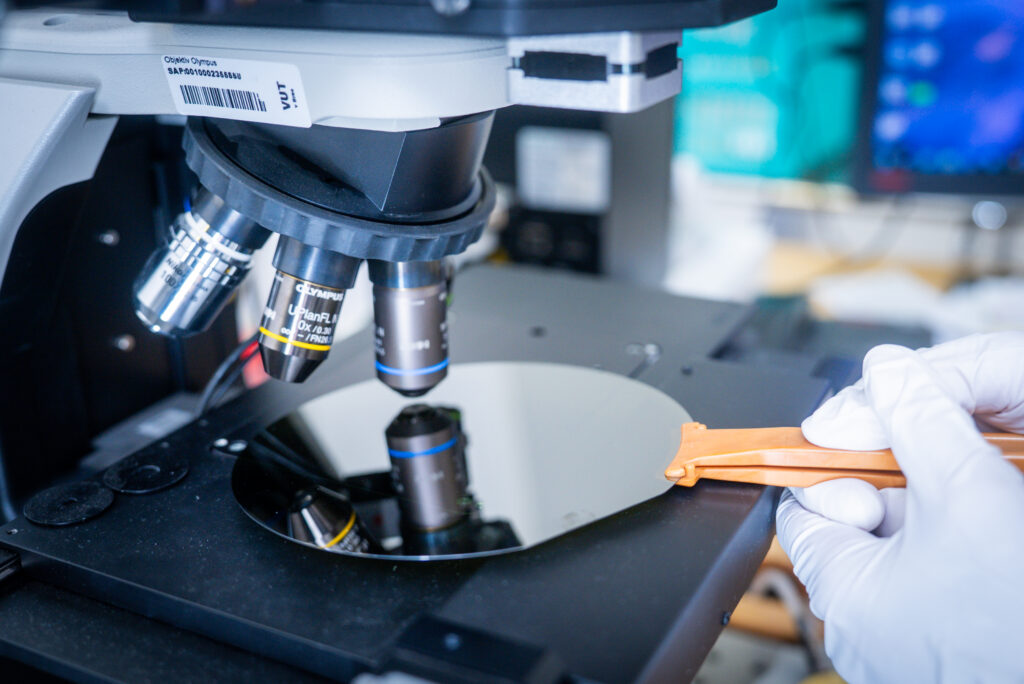
During her studies at the faculty, Helena acquired not only theoretical and practical skills but also presentation skills, which are also key for working in any company. At Researchers’ Night, she tried her hand at popularizing the field of semiconductors and chips for the general public. “After we unveiled our production process, most participants were surprised by how the manufacturing process unfolds—from a single grain of material through the monocrystal and substrate all the way to the finished chip. What pleased me most was that the topic captured their interest, and they subsequently bombarded me with questions. Moreover, many participants didn’t even know that this type of production exists here,” she explains.
How to Successfully Balance School and Work
Helena decided to pursue a Ph.D. while writing her master’s thesis. “During that process, I realized that working in science can be very interesting and that I enjoy it. What scares me is falling into a rut. Thanks to the opportunity to work on interesting projects as part of my Ph.D. program, I won’t easily end up in a rut at work,” she explains.
When combining studies with work, support from her supervisor and colleagues is essential for Helena. Moreover, her job responsibilities are structured to align as closely as possible with the topic of her doctoral studies. Personal motivation is also indispensable.
Companies, including onsemi, also recognize the importance of collaborating with the academic sphere to attract talented students. Helena considers gaining experience in the industrial sector while still a student to be her best career move. Thanks to this experience, students not only enhance their résumés but can also figure out which direction they want to take next. At the same time, it can make the transition from school to work easier for them. “A great opportunity is definitely Chemistry Day, where students have the chance to gather information and contacts from various companies and establish potential collaborations while still in school,” Helena recommends.
Helena believes that science offers many interesting fields where everyone can find something that suits them. She advises all students not to be afraid to try new things and to take full advantage of the opportunities the faculty offers. “If something appeals to you, go for it. The worst thing is to regret later that you didn’t dare,” Helena tells future scientists and engineers. Her own journey shows that if you have a clear goal and a desire to learn, doors will open for you even at the most prestigious companies.
Source: News at BUT (written by Jana Otoupalíková)
Photos by Filip Volf