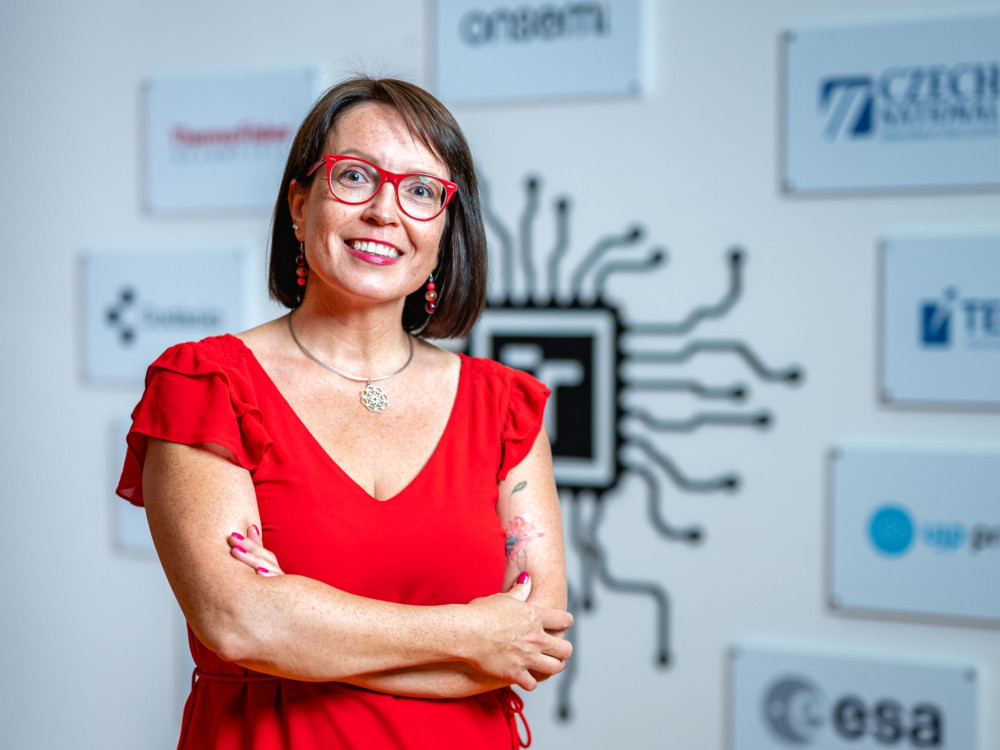
Jana Drbohlavová, Deputy Director of the Czech Semiconductor Center (CSC), has had an interesting journey from northern Moravia via Prague and Brno to Brussels, where she worked for six years at the European Commission. In July 2023, she returned to Brno to help build a center of excellence for semiconductor technologies, which aims to put the Czech Republic on the map of European leaders in this key area. The article for the university magazine News at BUT was prepared by Zdeňka Koubová from FEEC.
From coordinator to deputy director
Jana Drbohlavová started as a project coordinator for the creation of the competence center and is now the deputy director of this institution. The center, based at BUT, is a newly created independent unit at the level of university institutes. “Four parts of BUT are involved: the Faculty of Electrical Engineering and Communication Technologies (FEKT), the Faculty of Mechanical Engineering (FSI), the Faculty of Information Technology (FIT), and CEITEC. All of these departments teach subjects that are important for the semiconductor chain,” she explains.
The center operates as a consortium of six partners. In addition to BUT, these are JIC, Codasip, the Czech National Semiconductor Cluster (all based in Brno), CTU in Prague, and onsemi in Rožnov pod Radhoštěm.
The road to semiconductors via Brussels
Jana Drbohlavová’s professional career path is somewhat unusual. Originally a graduate in physical chemistry, she went to Brussels as a national expert for a year with her son and ended up staying there for six years. During her time at the European Commission, she was involved in the creation of European chip legislation as an observer from the Directorate-General for Research and Innovation.
“At that time, we were already working remotely with Stanislav Černý (president of the Czech National Semiconductor Cluster, ed.) and David Uhlíř from JIC. We would meet from time to time as a platform for semiconductors, and after my return, we began to work intensively on the creation of a competence center,” she recalls.
The European Chip Act was based on three pillars: the Chips for Europe initiative, support for the creation of first-of-a-kind infrastructure in Europe, including the construction of new production lines, and ensuring security of supply in the event of a crisis similar to the COVID-19 pandemic.
Why are chips so important?
“Chips are everywhere,” emphasizes Jana Drbohlavová. “We need them in everything from mobile phones and washing machines to cars, medicine, and space development. Everyone needs different chips in terms of energy requirements and development.” She points out that during the pandemic, companies even lacked chips for car windows.
According to her, Europe has great potential in the fabless sector, i.e., chip design. “While global turnover in the chip design industry has increased by 170 percent over the past 10 years, Europe’s share has fallen from ten to seven percent. Europe must therefore significantly increase the number of fabless companies and the number of employees in the field of chip design in order to maintain its importance in the global market. The goal is a 20 percent increase in Europe’s total share of global chip production.”
International cooperation and Silicon Europe
The Czech National Semiconductor Cluster (CNSC) is a member of the Silicon Europe alliance, which brings together twelve clusters. “It is a very strong combination of technological knowledge and resources from leading European research institutes and companies, which significantly supports the initiatives of the European Chip Act,” explains Drbohlavová. The CNSC cooperates particularly closely with Silicon Saxony, Minalogic, and Silicon Alps.
The South Moravian Region is also a member of the European Semiconductor Regions Alliance (ESRA) together with the Zlín Region, where onsemi and Tomáš Baťa University operate, and the Plzeň Region with power electronics at the University of West Bohemia.
From automotive to medicine
The competence center has selected several sectors as promising areas. “Automotive is one of the areas, and when the center opened in April 2025, we invited companies from this sector to a pilot workshop. We would like to hold similar meetings with other sectors such as cybersecurity, energy, defense, and medicine,” plans Jana Drbohlavová. Chips in medicine are not just devices in the operating room. “They are also technologies that can help with imaging, sensors, and modern non-invasive methods,” she adds.
A cookbook for chips and working with schools
Jana Drbohlavová taught a course called Practical Chemistry for Electrical Engineers at FEKT. “I saw that students lacked all the know-how in the field of chemistry, they were afraid of the chemistry lab and were often afraid to mix individual substances,” she explains why they introduced the course.
Together with her colleagues Imrich Gablech and Jan Brodský, she also created a lecture called Cookbook for Chips, which describes the processes involved in chip preparation, from silicon wafer oxidation to various lithographic treatments. “My colleague Veronika Junasová added an entertaining element for secondary schools by using my son’s dismantled Lego police station to show students how individual layers are prepared and etched,” smiles Drbohlavová. In this way, the center helps to fulfill the action plan for active participation by BUT and CTU with lectures at at least fifty secondary schools, not only in the South Moravian Region. “My colleagues and I also visited my alma mater, the Gymnasium in Vítkov, and Veronika went to Banská Bystrica in Slovakia.”
European network of competence centers
The center is part of a network of thirty competence centers across Europe (aCCCess) that aim to provide assistance to small and medium-sized enterprises throughout the EU. “For example, if a company from Malta needs expertise on RISC-V or something else they lack, they can turn to our center, which provides training on this technology. Conversely, if we need to address something that is not our primary area of expertise, we turn to the European centers,” she explains the principle of cooperation.
Brno as a green city
Jana Drbohlavová chose Žabovřesky in Brno as her home. “I consider Brno to be a very green city,” she says. She and her colleague even grow tomatoes and peppers at FEKT. How does she manage to balance family life and caring for two children with her position as a scientist and representative of the semiconductor sector in the Czech Republic? “We can’t let any client down,” she laughs, adding that open communication and mutual support are key for her not only at work but also in life.
Source: News at BUT (Zdeňka Koubová)
Photo: Jakub Rozboud