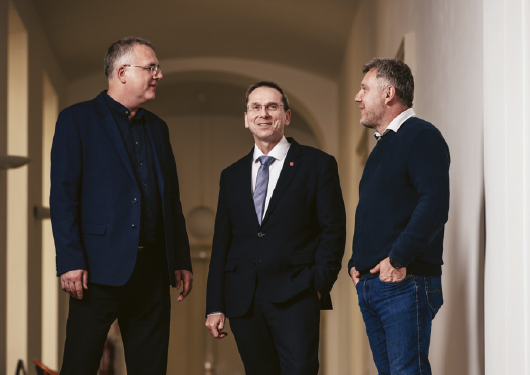
We sat three chip experts at one table and discussed everything with them — from nanometer-scale manufacturing processes to gigantic geopolitical risks. Semiconductors are such a broad topic.
The setting is the bright office of Ladislav Janíček, Rector of Brno University of Technology, who unfortunately has to leave halfway through the conversation because duties call and his calendar is relentless. Still, he is a generous host and lets us finish the debate in his office — even though it stretches on for at least another hour, during which he manages to fit in three other meetings.The other two participants, Michal Lorenc and Karel Masařík, luckily don’t have such packed schedules that day, so we cover around twenty different topics — and yet still can’t encompass the whole chip industry.
“The semiconductor ecosystem is evolving incredibly fast in new directions,” explains Lorenc, R&D project leader at Onsemi’s Rožnov chip factory, though today he’s speaking mainly as vice president of the Czech National Semiconductor Cluster. “Be it new processor architectures like RISC-V, overlaps into quantum technologies, or artificial intelligence — whether that means hardware for AI or using AI for chip design. The changes are plenty, and they’re happening at breakneck speed.”
The hard reality, however, is that in this constantly shifting and growing semiconductor world, Europe has been lagging behind — and its wake-up call was anything but pleasant.
Europe has only about a ten percent share of the global chip and semiconductor market, yet it has committed to raising that to at least twenty percent by 2030. “But realistically, that would require Europe to quadruple its activity, because the world won’t stand still and the global semiconductor market will double again in the meantime,” notes Karel Masařík, known from Forbes as the founder of Moravian chip wonder Codasip, but now mainly chairing the newly established Czech Semiconductor Center.
“One of the Center’s goals is to lower the barrier for young companies to access expensive technologies, because semiconductors are truly costly in research, development, and production,” says Masařík.
Source: Forbes Next (more details in printed version, now available at newsstands)
Kristýna Tmejová, Risto, Tomáš Škoda