
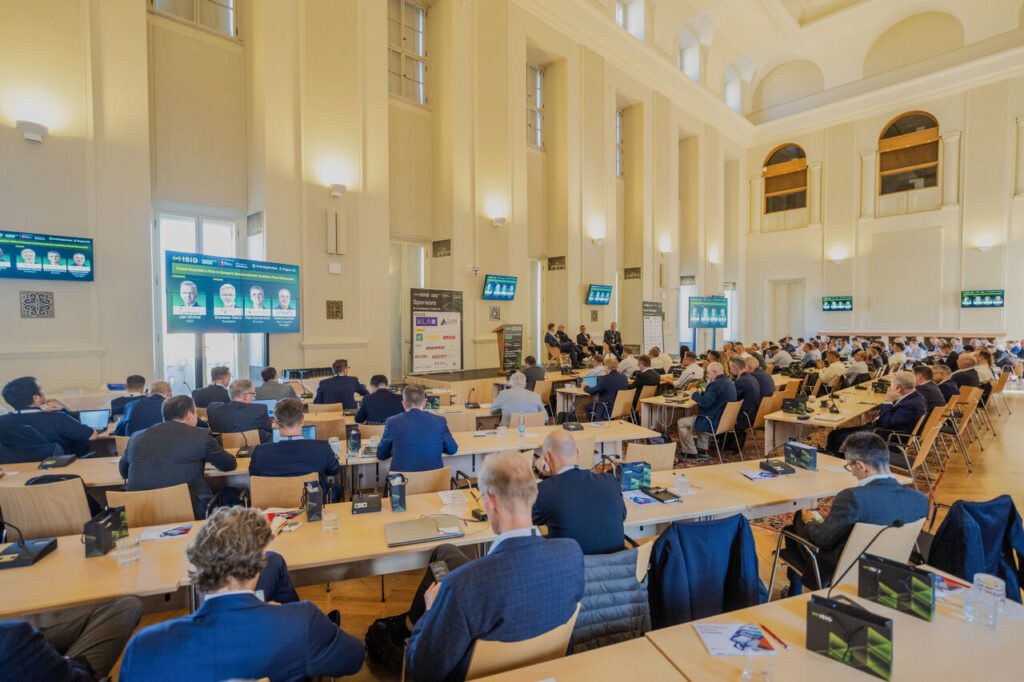
Czech Semiconductor Centre Director Petr Kamenický joined senior representatives of the Czech and international semiconductor industry at the ISIG Executive Summit EU 2026 in Prague, contributing to a panel discussion on how Czechia can strengthen its position within Europe’s semiconductor ecosystem.
The ISIG Executive Summit EU took place in Prague from 14 to 16 September 2026, with the main summit programme hosted at the historic Černín Palace on 15–16 September. Under the theme “Chips, Power & Machines: Powering AI and Electrifying Industry”, the event brought together semiconductor executives, technology providers, researchers, investors and public-sector representatives to discuss the future of the industry, including power electronics, AI, advanced manufacturing and European semiconductor policy.
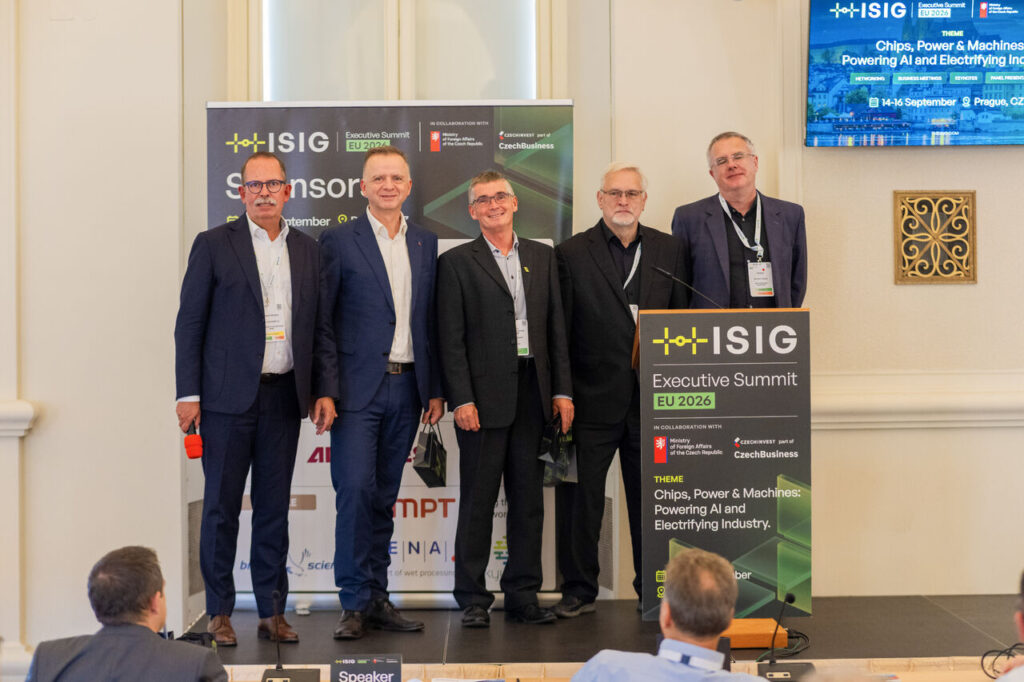
One of the programme’s key discussions focused specifically on “The Czech Republic’s Role in Europe’s Semiconductor Ambition”. The panel brought together Petr Kamenický, Director of the Czech Semiconductor Centre; Stanislav Černý, President of the Czech National Semiconductor Cluster (CNSC); and Michal Lorenc, Vice President for Industry of the CNSC and R&D Program Manager at onsemi. The discussion was moderated by Jan Michal, CEO of CzechInvest.
Building distinctive strengths rather than an entire national supply chain
One of the central questions was where Czechia can create distinctive value within the European semiconductor ecosystem – whether through power semiconductors and SiC technologies, chip design and IP, photonics, advanced materials, packaging, metrology, semiconductor equipment or a combination of these areas.
Kamenický argued against attempting to identify a single national technology winner in advance. Instead, the priority should be to create an environment in which areas of genuine technological and industrial excellence can emerge, grow and connect to European capabilities.
From the CSC perspective, Czechia does not need to reproduce an entire semiconductor supply chain within its borders. Its opportunity lies in developing distinctive capabilities backed by strong industrial R&D, excellent research teams and links to European infrastructure and markets.
The ultimate objective is not national technological self-sufficiency, but a position in which Czech expertise becomes difficult to replace within a distributed European semiconductor value chain.
Industrial R&D as the bridge between research and the market
Another major topic was the relationship between companies, universities and research organisations.
According to Kamenický, strong industrial R&D teams play a particularly important role because they can define real technological challenges, absorb research results and turn them into products and solutions.
Manufacturing capacity can, in some circumstances, be relocated through an investment decision. Deep technological know-how, experienced engineering teams and accumulated R&D expertise are considerably more difficult to recreate elsewhere.
The same principle applies to talent. Attractive engineering jobs encourage students to enter semiconductor-related disciplines, while companies depend on universities to educate future specialists and generate new knowledge. Networking can help start these relationships, but it is not sufficient on its own.
European infrastructure must lead to real products
The panel also addressed the implementation and future development of the European Chips Act, including European pilot lines, chip competence centres and the European Design Platform. Kamenický highlighted the importance of using the entire European network rather than expecting each national competence centre to cover every semiconductor technology itself.
In this model, a competence centre serves as a trusted national entry point into European capabilities. However, access to infrastructure alone is not enough. Companies also require technical guidance, clear access conditions and financing that allows them to continue from an initial prototype through validation, scale-up and commercialisation.
One of the most significant challenges identified during the discussion was precisely this transition from successful research and prototyping to a market-ready product.
CSC should be more than a signpost
For the Czech Semiconductor Centre, this challenge directly defines its role. Asked what CSC should deliver that Czech companies – particularly SMEs and start-ups – cannot easily access today, Kamenický stressed that the Centre should function as a technical front door rather than simply a referral point.
A company approaching CSC with a technical challenge or product ambition should be able to identify a credible development route: the appropriate specialists, access to the relevant European Design Platform or pilot line, the next technical milestone and the possible financing and market pathway.
For smaller companies, the main obstacle is often not a lack of publicly available information. The challenge is combining specialised expertise, costly infrastructure, intellectual property conditions, funding opportunities and market access into one workable development process.
CSC’s role is therefore to reduce this complexity and help manage the handover between individual stages and partners.
“CSC must be more than a signpost. It should help companies execute the route from technical need to European capability and market.”
At the same time, European cooperation should be complemented by the development of Czech areas of excellence that respond to genuine industrial demand. This would allow Czechia not only to access European semiconductor capabilities, but also to contribute expertise that other European partners need.
What would success look like in 2030?
Looking towards 2030, Kamenický described success as a combination of globally competitive Czech companies and intellectual property, international investment, strong industrial R&D and specialised capabilities embedded in European value chains.
New manufacturing investment can form an important part of this development, particularly when it is connected to local research, engineering talent, suppliers and product responsibility. The broader ambition, however, is strategic interdependence: creating capabilities that make Czechia a valuable and difficult-to-replace part of the European and international semiconductor ecosystem.
Achieving this will require a durable connection between industrial R&D, university excellence, European semiconductor infrastructure and scale-up finance – bringing innovation, talent development, technology transfer and company growth together rather than addressing them separately. For the Czech Semiconductor Centre, helping companies navigate and use these connections is at the heart of its mission.
Photos: ISIG LinkedIn