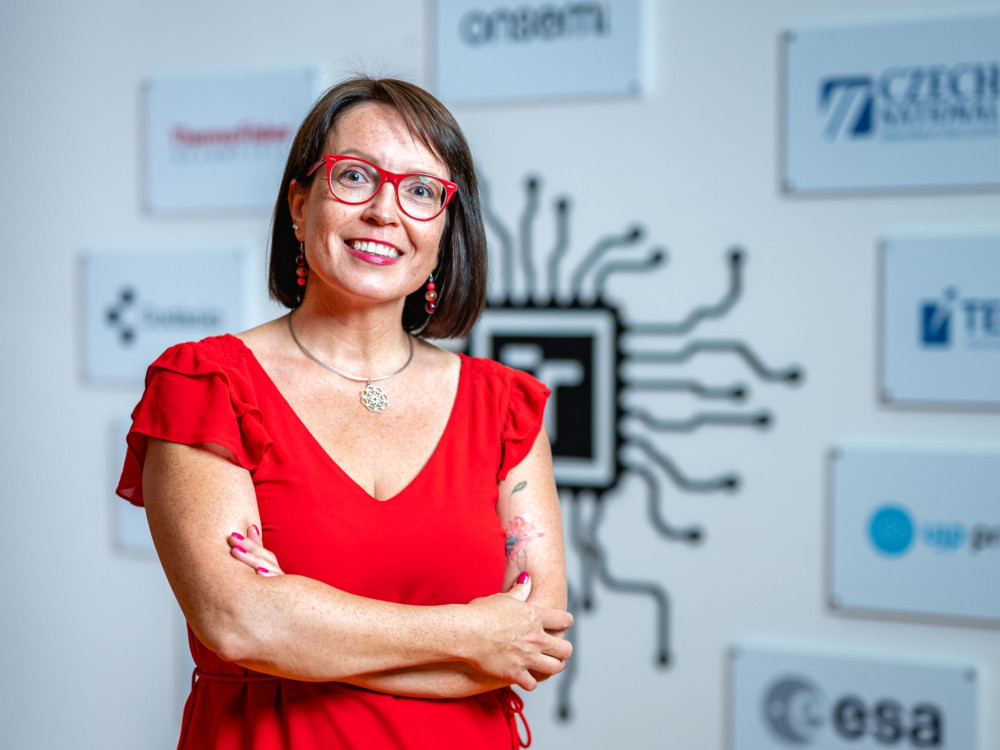
In April 2025, the Czech Semiconductor Center opened, with Doc. Ing. Jana Drbohlavová, Ph.D., as its coordinator. Her professional career proves that there is definitely a place for women in (electrical) engineering. After all, chips are found in phones, watches, or microwave ovens. And if women use them regularly, why shouldn’t they develop them regularly? Found more at interview for What news magazine.
What does a typical day look like for a female scientist?
After returning from Brussels, where I was sent by the university for a few years as a national expert (SNE), I started working as a designer and later as deputy director of the center for semiconductor technologies. We help small and medium-sized enterprises and start-ups in the Czech Republic to develop their business and transfer research results within the Czech Republic and abroad. So I may disappoint you – I now work in an office and my day is about setting up our center’s services to help boost chip production in the EU to 20 percent of global production.
That sounds interesting. What was your ideal day in the lab like?
It was when I came to work, all the equipment was working, and I didn’t get burned by any chemicals. I rarely wore a lab coat, so I had holes all over my T-shirts and blouses and had to learn to sew them up very creatively. And at the end of an ideal day, after all that “cooking” of various quantum dots or gold and silver beads, when all the nanoparticles produced were the right size, stable, glowing, and behaving as they should, I could feel good about having “cooked” something that I could pass on to others.
And what did you develop in that laboratory?
I focused my research on nanomaterials for medicine and sensors for monitoring environmental pollution. For example, in collaboration with Mendel University in Brno, we developed sensors for detecting phosphorus and nitrogen content in order to monitor the chemical balance in pond waters. Climate change, fertilizer runoff into ponds, and rising temperatures all cause oxygen depletion. We invented a device that quickly analyzes the composition of water and pond sediment and helps prevent fish deaths, which result in significant economic losses.
And then they say science can’t save the world…
Biomedicine is close to women’s hearts because it is so human, even though it is still a technical field. We women still have a tenderness and desire to help; we want to heal and save things. That’s why the biomedical application of my sensors was more appealing to me than making chips for cell phones.
Speaking of Brno, if I ignore the jokes about Brno spread by malicious city dwellers, one would not expect such a large technology center to be built here…
You see, every third electron microscope in the world is manufactured here in Brno. There are four companies here that deal with electron microscopes, which are important for the characterization and analysis of chips, among other things, creating an excellent platform for the development of the field. The only large semiconductor manufacturer, onsemi, was built in the former Tesla Rožnov and is now waiting for an investment incentive to build a huge line for the production of silicon carbide-based chips. This is a semiconductor with a large bandgap, which means that this material has low energy consumption, and since we want devices with low energy consumption, we need such chips.
How did you end up in a laboratory full of nanoparticles?
When I was very young, I considered studying veterinary medicine. I still remember asking my mom if I would have to take care of cows and pigs too. The answer was yes, so I switched to biology and chemistry. My dream was to study pharmacy and become a pharmacist, but I failed the entrance exams, paradoxically in physics. So I turned my attention to chemistry and stayed there. What’s more, I was discouraged when I noticed during a student job at a pharmacy that I wouldn’t have a proper laboratory there and would function more as a salesperson than a researcher. So I ended up studying physical chemistry and joined the research department at the university.
What is so adventurous about science?
Research has shown me how everything can be connected and how everything works. When I look at a lab full of instruments, the adventure is learning how to use them all to get results. Even if it’s a tiny step that helps someone, it’s still there and you can be happy about it.
You spent some time in Brussels as a national expert. These opportunities aren’t often written about, but for me, it’s a great professional and personal boost.
Each member state has a quota for the number of national experts it can send. I was lucky because people from ministries are usually sent, not from academia. I discovered the position by chance thanks to my collaboration with the South Moravian Innovation Center. The European Commission was looking for someone to work on nanomaterials, assessing their safety and creating guidelines for their use. It was a big leap for a lab rat, because it took me a while to switch to the bureaucratic bubble, especially since I had to learn about legislation, but the insight was worth it.
What insights did you bring back with you?
When you live abroad for a few years, you realize that you can manage everything. I even gave birth and raised my children there, so I realized that you can handle anything. My English also improved a lot because the Commission supports employees in language courses. From a work perspective, I understood how the European Commission works in cooperation with the Parliament and the Council and how to use this for my field and my country. How to write a high-quality, defensible project, what to recommend to others.
Would you recommend others to try a similar adventure in Brussels?
Definitely. You have the opportunity to do everything from Blue Book training in European institutions for students of political science, languages, and technical fields to several-month or year-long internships. It’s usually for one to two years, but you can extend your stay to four or even six years. I was lucky to be able to extend my stay, even with a short break for maternity and parental leave.
On the contrary, what memorable career advice did you receive?
No matter what happens, don’t give up yet. Then a figurative kick from someone who knew that if there was no solution, we wouldn’t push it further, but if there was, then let’s try again. Professor Vojta Adam had a big influence on me, filling us all with kindness and enthusiasm. He always said, “Now let’s explore this.”
What advice would you pass on to the world now?
Work is just work. No matter how much you like it, don’t let it grind you down, because then you’ll be sad that you don’t have time for your children, for example. Do your work and then make time for your family or yourself.
Finally, what message would you send to people who still loudly claim that women are not good at technology and mathematics?
That I didn’t do well in physics at first either. I am a physical chemist, but I was lucky to have kind colleagues from the engineering faculty from whom I could learn. For example, the physics of layers and condensed materials. So I would like to encourage girls to stop being afraid of technology. Don’t discourage girls from studying mathematics and physics, but devote yourself to them. It’s time to finally break this barrier; it should be a shared ambition of parents and teachers. Tell girls that they can be whatever they want to be, even a physicist, an astronaut, or a super scientist. Today’s possibilities are enormous; you can continue your education, attend clubs, and study things on the internet. For example, in Brno, we have a FABLAB workshop where children can try 3D printing, carpentry… A creative FABLAB truck also travels around the country. It is up to us to bring technical subjects to children.
Source: What news