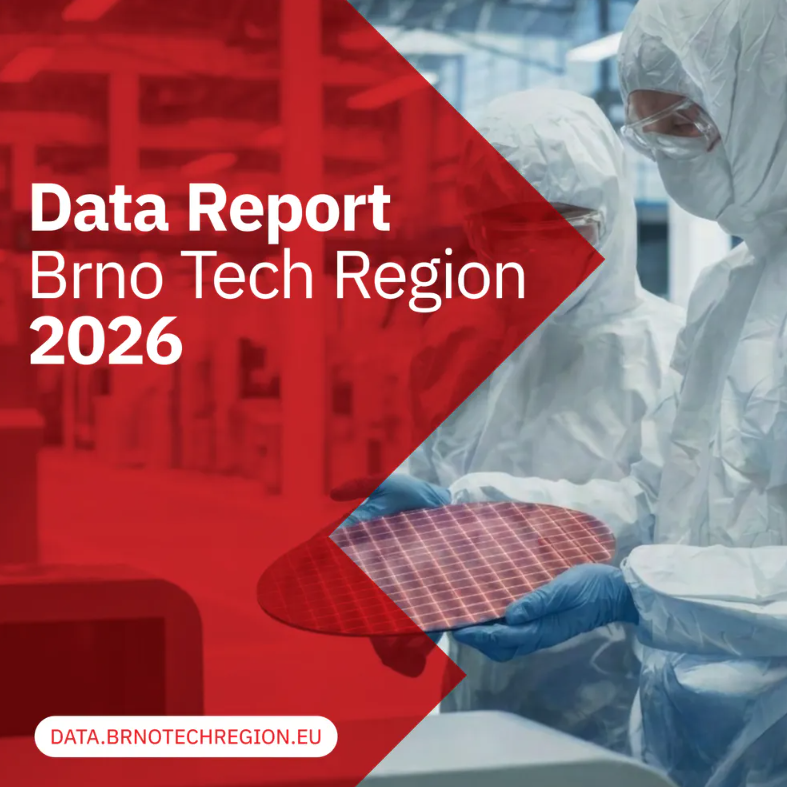
The latest Brno Tech Region Data Report places semiconductors among the industries shaping the region’s technological future. With a silicon wafer featured prominently on its cover, the report reflects Brno’s growing importance in chip design, specialised software, electron microscopy, research and technical education.
The Brno Tech Region Data Report 2026 presents the latest available figures on research, innovation, entrepreneurship and talent in Brno and the wider South Moravian Region. Published annually by the JIC innovation agency and other partners in the regional innovation ecosystem, this year’s edition explicitly recognises chip development as one of Brno’s key areas of technological expertise.
According to the report, approximately 500 experts in Brno work directly in chip design and the development of specialised electronic design automation software. This makes the city the principal centre of chip development in Czechia.
Technologies intended for global markets are developed locally by companies including Codasip, onsemi and NXP Semiconductors. The industrial base is complemented by research at Brno University of Technology, Masaryk University and CEITEC. The report also highlights the arrival of Elmos Semiconductor, which opened an R&D centre focused primarily on automotive semiconductor solutions in Brno in 2025.
The ecosystem is not limited to large international companies. Local semiconductor and technology start-ups are also expanding internationally. The report mentions DynaNIC, which was included among Deloitte’s “Companies to Watch”, and DG Solutions, which is developing its presence in Taiwan. Codasip is also listed among the five largest Brno-based recipients of Horizon Europe funding.
Brno is also home to the Czech Semiconductor Centre, which helps start-ups, SMEs and research teams access expertise, European pilot lines, design infrastructure, funding opportunities and international partnerships. Its inclusion in the report reflects the increasingly structured support available to organisations developing semiconductor technologies and chip-enabled products.
Electron microscopy as part of the semiconductor value chain
One of Brno’s most significant advantages lies in capabilities that extend beyond chip design itself. The city is a global centre for electron microscopy — an industry closely connected with semiconductor research, material characterisation, nanoscale measurement and the analysis of increasingly complex components.
The report estimates that every third electron microscope in the world originates in Brno. The region’s leading microscopy companies, including Thermo Fisher Scientific, TESCAN and Delong Instruments, employ more than 2,900 people, generate approximately EUR 1.5 billion in turnover and invest more than EUR 82 million annually in research and innovation. When related suppliers are included, the sector provides employment for as many as 5,000 people in the region.
This concentration of expertise represents an important asset for the semiconductor industry. Chip development and production depend not only on circuit architecture, but also on advanced instrumentation, metrology, materials research, diagnostics and quality control. Brno’s strength therefore lies in its ability to connect multiple parts of the technology and supplier chain within a relatively compact ecosystem.
The interaction between microscopy and semiconductor applications is already generating international results. The report notes, for example, that technology developed by Brno-based NenoVision began to be used by NVIDIA in 2025.
Rapid growth in high-tech research investment
The semiconductor ecosystem benefits from the region’s exceptionally strong research base. Corporate expenditure on R&D in the Brno Region reached a record EUR 610 million in 2024, representing an increase of 73% over ten years.
Particularly relevant is the development of the electronic and optical equipment sector. R&D expenditure in this area more than quadrupled between 2015 and 2024, rising from EUR 20.8 million to EUR 90.9 million. Together, IT and the production of electronic and optical equipment now account for 55% of all corporate R&D expenditure in the region and more than 83% of its growth since 2015.
Total public and private R&D expenditure in the region reached EUR 1.04 billion in 2024. At 2.9% of regional GDP, South Moravia has the highest research intensity in Czechia and remains above both the Czech and European Union averages. Brno itself accounts for 94% of the region’s research expenditure.
The region has also attracted more than EUR 167.5 million through Horizon Europe since 2021, equivalent to 28.2% of all funding awarded to Czech organisations through the programme. This ability to participate in international research projects is particularly important for semiconductors, where development increasingly requires cooperation across countries, disciplines and different stages of the value chain.
A strong, but highly sought-after, talent base
Access to qualified specialists remains one of the semiconductor industry’s greatest challenges. The data nevertheless show that Brno has one of the strongest technical talent pipelines in Czechia.
In 2025, the city’s universities had 68,236 students, including 23,602 students in STEM disciplines. Engineering, manufacturing and construction accounted for 12,282 students, while the number of ICT students reached 6,408 in 2024 — an increase of 12.3% compared with 2020. One-third of all technically oriented university students in Czechia study in Brno.
The region also has a substantial base for advanced research. In 2025, 2,649 doctoral candidates were studying STEM subjects in Brno, including 664 in engineering, manufacturing and construction. Almost one-quarter of all university students in the city come from abroad, strengthening the international character of its research and technology community.
Brno University of Technology has responded to semiconductor industry demand by launching dedicated bachelor’s and master’s programmes in Chip Design and Modern Semiconductor Technologies. The programmes build on the university’s long-established expertise in microelectronics and prepare graduates for careers in integrated circuit design, testing, semiconductor technologies, research and production.
Turning regional concentration into European opportunities
The Data Report 2026 shows that Brno’s semiconductor potential cannot be described through a single company or indicator. Its competitive advantage comes from the concentration of chip designers, EDA specialists, microscopy manufacturers, researchers, technical universities, start-ups and internationally connected development centres.
This combination creates opportunities that extend well beyond the city itself. Through the Czech Semiconductor Centre and its partners, regional expertise can be connected with European design platforms, pilot lines, funding instruments and industrial cooperation under the European Chips Act.
The figures confirm that Brno already has a strong foundation. The next step is to turn this concentration of knowledge into more validated technologies, growing companies, skilled graduates and commercially successful semiconductor products.
The complete Brno Tech Region Data Report 2026 is available here.