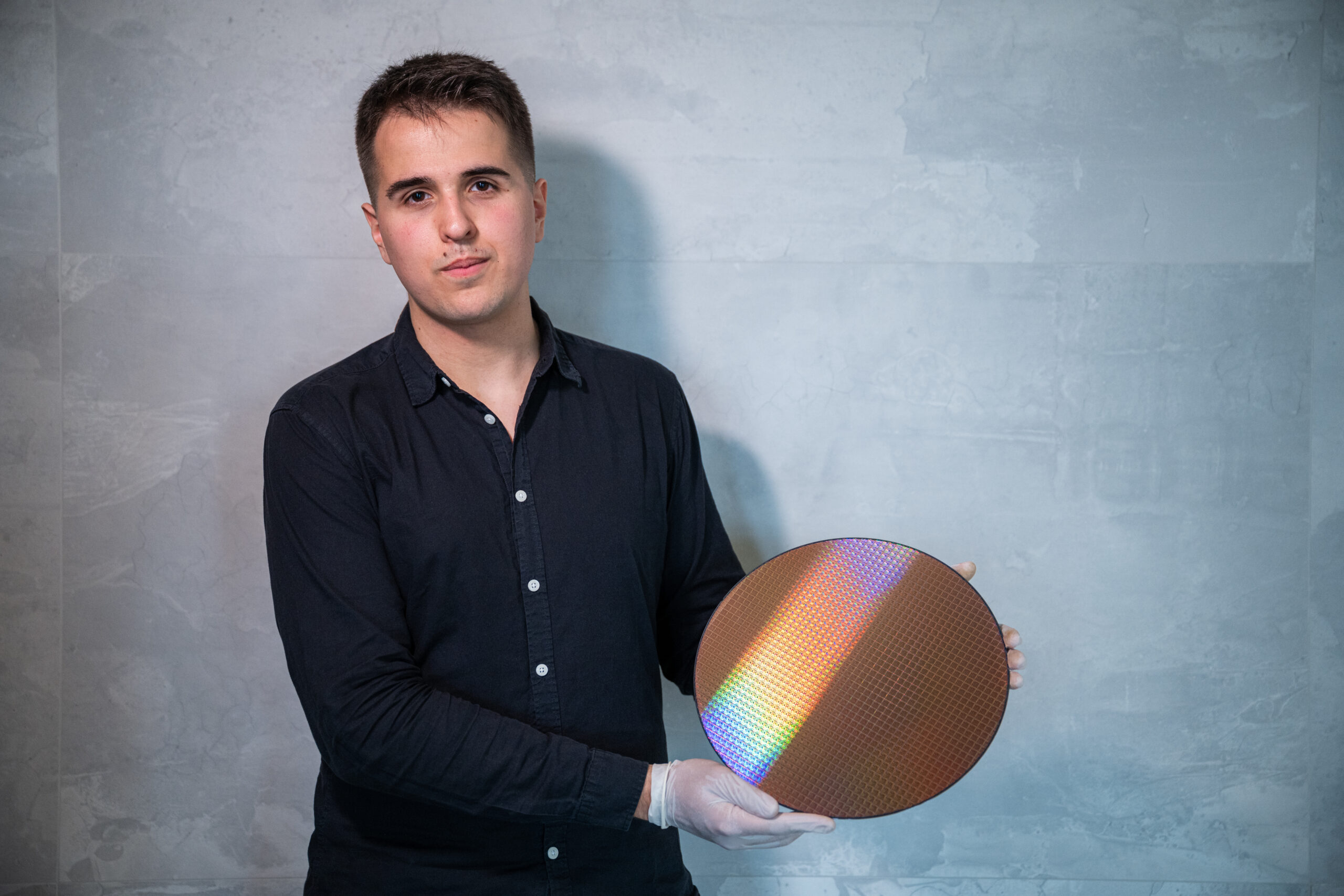
Still in its infancy, but with bold ambitions, a student initiative focused on chips and semiconductors is emerging at BUT. It is the brainchild of Martin Balabán, a student at the Faculty of Mechanical Engineering and the Faculty of Business and Management, who, together with his friend Lukáš Lev from the Faculty of Electrical Engineering and Communication Technologies, is currently turning plans into reality. Activities under the SPICE brand do not yet have official status, but the founders make no secret of their ambition to become a creative student team that will take on the topic of semiconductors at the university. The article was written by Iveta Hovorková for the university magazine News at BUT. You can meet Martin at a number of events associated with the Czech Semiconductor Centre, such as the Science and Technology Festival, Electron Microscopy Days, and others.
Martina Balabán was drawn to semiconductors and chips by his studies in physical engineering at the Faculty of Mechanical Engineering. In his third year, he had the opportunity to go on a month-long internship in Taiwan. “That’s where I got my first taste of them, because Taiwan is a world leader in chip manufacturing,” says Balabán. And the numbers back up his words: Taiwan accounts for more than 60 percent of global semiconductor production and more than 90 percent of the most advanced chips. “It’s important to realize that studying physics offers extremely broad possibilities: from theory to optical optics to semiconductors. I can say with some exaggeration that out of thirty students in my class, each one focuses on something different. I was interested in chips, mainly because of how big the market is and what it encompasses,” adds Balabán.
In his fourth year, in addition to studying physics, he also added Strategic Business Development at the Faculty of Business and a part-time job at the Institute of Microelectronics at FEEC. “Thanks to my studies at the business school, I am gaining soft skills that I think I was lacking before. I am studying management, marketing, the basics of economics… I would like to use these soft skills during my studies and then in practice. I don’t want to be locked up in a lab, so I’m looking for a way to combine technical knowledge with the ability to lead a team or project,” says Balabán.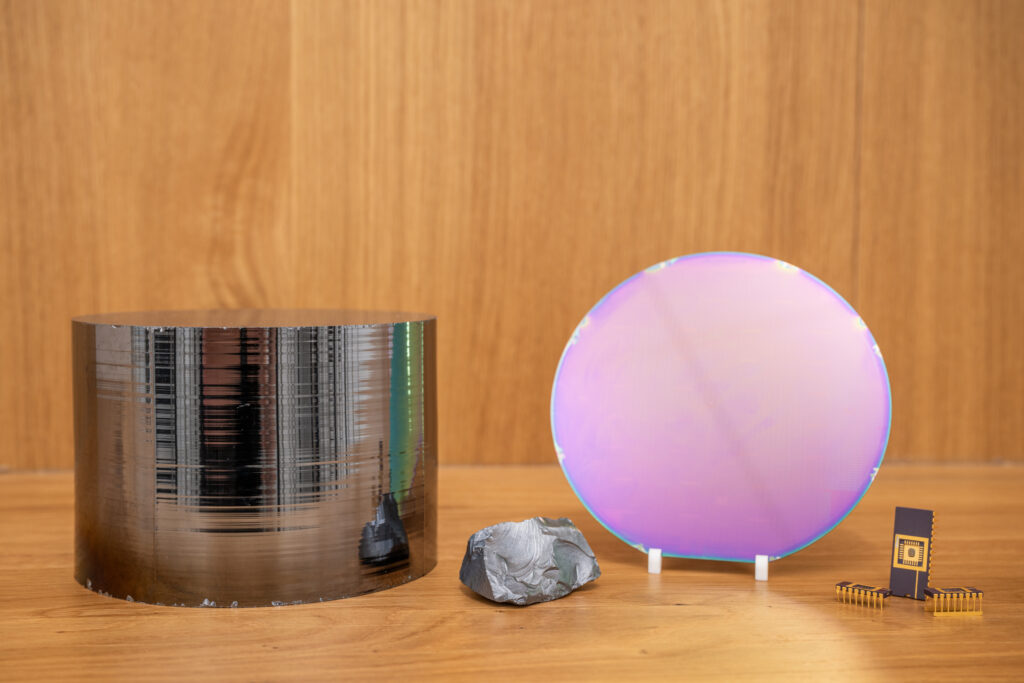
And it seems he has found it. He came up with the idea of founding a student creative team that would focus on semiconductors, chips, and solid-state physics. Together with his friend Lukáš Lev from FEEC, he is gradually launching activities for which they want to obtain official status as a BUT student creative team in the future. They named their team SPICE. “It’s an acronym: Semiconductor Physics, Integrated Circuits, and Electronics. We wanted it to be memorable and easy to pronounce. We sometimes say that students can spice up their lives a little with team activities. At the same time, SPICE was one of the first programs for designing integrated circuits, and it is still used as a basis today,” explains Balabán.
He himself is a fan of club activities, but as he says, as a physics student, he did not find the ideal fit in any existing team. “I was on the Formula team for one season, I tried strojLAB… But it seemed to me that physics engineering students don’t participate much in club life, which I think is a shame. At the same time, I was inspired by the establishment of the Czech Semiconductor Centre, which is, of course, a European-level organization, so I don’t expect there to be much room for student involvement there,” Balabán describes.
SPICE is not intended to be a place only for physics students, but will offer a space for sharing and education for all fields and specializations related to the topic. “The chip ecosystem starts with materials and chemistry, then there’s electronics and chip design, and someone has to program and test them. So there will be space for students from FSI, FEEC, FIT, the Faculty of Chemistry, and others,” Balabán hopes. He has received positive feedback from both students and teachers so far, so he and his colleague would like to gradually launch the SPICE initiative.

“We are planning two types of activities: internal activities focused on member development, i.e., a space for sharing and looking beyond the horizon of one’s own expertise into other areas related to chips and semiconductors. We are also considering a joint student project where we could test our knowledge in practice. In addition, we are planning outreach activities aimed at the general public. We want to show people that even though chips themselves are very complex and sophisticated, the basic principles can be understood by anyone,” says Balabán, adding that SPICE can currently be followed on LinkedIn and will soon be on Instagram as well.
Last but not least, the team also has ambitions to establish cooperation with companies in the field. “The benefit for companies is clear: access to talented students. In return, we could gain opportunities for internships or lectures by industry experts for our members. I believe the potential is great. Just look around you to see where you can find chips and semiconductors everywhere,” concludes Balabán.
Source: News at BUT (Iveta Hovorková)
Photo: Václav Široký