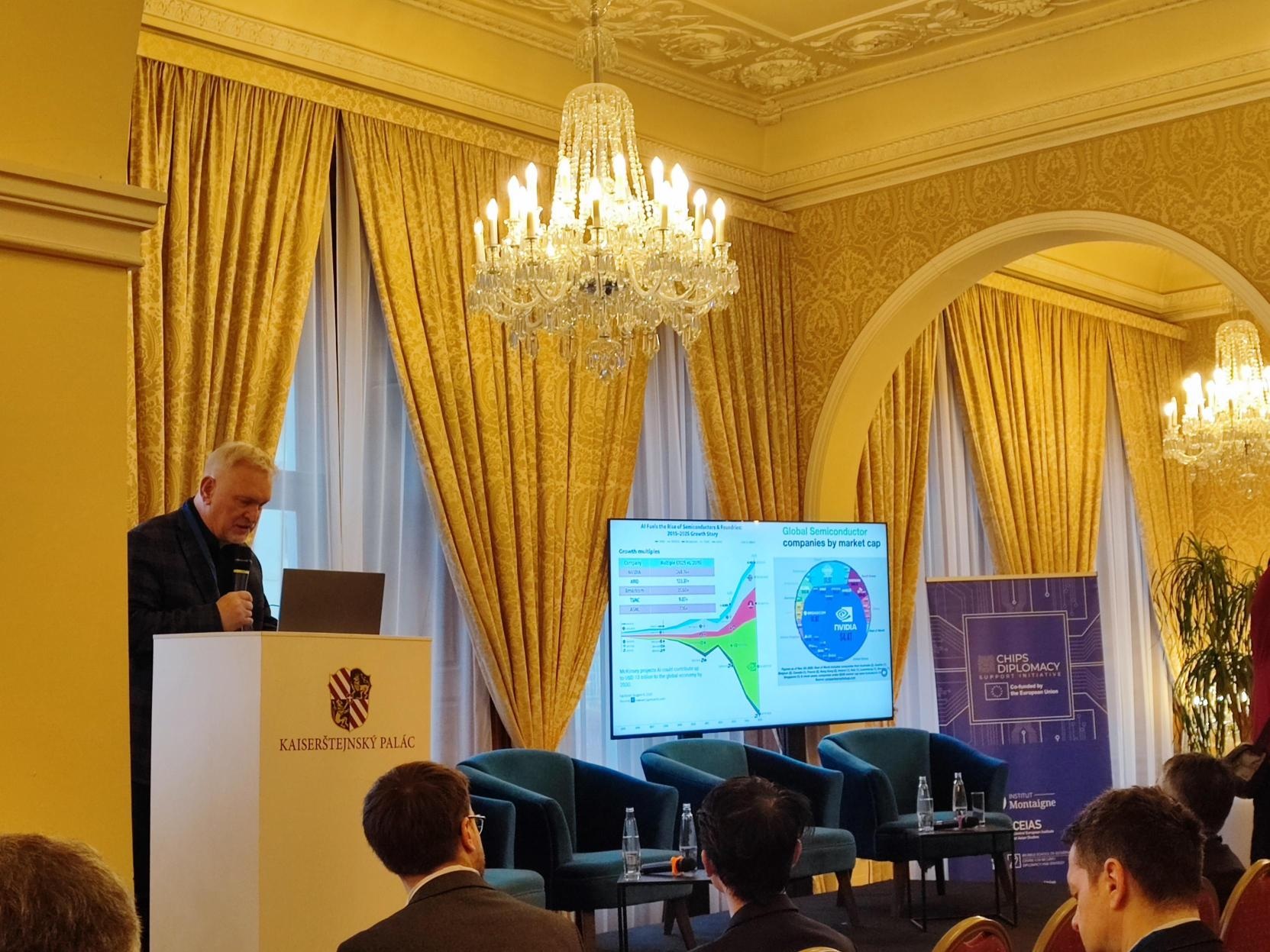
Leading figures from industry, government, academia and policy circles gathered in Prague on Tuesday January 27th for the international conference Bridging the Gap: Central Europe’s Silicon Future. Hosted at the historic Kaiserstein Palace in Malá Strana, the event was organised under the CHIPDIPLO initiative, co-funded by the European Commission, in cooperation with the Czech National Semiconductor Cluster and the Czech Semiconductor Centre.
Against the backdrop of intensifying global competition, supply-chain vulnerabilities and the implementation of the European Chips Act, the conference focused on the growing strategic importance of Central Europe within the European semiconductor ecosystem. Throughout the day, speakers and panellists explored how the region can strengthen Europe’s technological resilience, competitiveness and strategic autonomy.
Keynote addresses from Stanislav Černý, President of the Czech National Semiconductor Cluster, and Lucie Krčmářová, Director of the Department of Sectoral Expertise and Industrial Policy at the Ministry of Industry and Trade of the Czech Republic. Both highlighted Central Europe’s strong industrial base, engineering talent and innovation potential, while underlining the need for coordinated policy frameworks and long-term investment to fully leverage these strengths. “We are delighted that the Czech Semiconductor Centre has been able to join the European network of competence centers, aCCCess,” said Krčmářová.
The morning programme opened with a high-level panel on Europe’s role in the U.S.–China tech rivalry. Experts from academia and think tanks discussed the geopolitical dimensions of semiconductor supply chains and the implications for European security and economic sovereignty. The discussion stressed the need for Europe to act with greater coherence, reduce strategic dependencies and position itself as a credible and reliable global partner.

This was followed by a policy-focused panel examining how Central European countries can lay the foundations for a stronger semiconductor role within the EU. Speakers from Slovakia, Czechia and Poland shared perspectives on national strategies, EU-level instruments such as Chips JU, and the importance of cross-border coordination in areas ranging from research funding to investment attraction. “I truly believe that everything starts with talent coming from universities, which is why the two largest technical universities in Czechia — from Brno and Prague, BUT and CTU — are part of the Czech Semiconductor Centre. However, the ecosystem is not built on technical skills alone. While these are strongly developed together with our industrial consortium partners, entrepreneurship and an entrepreneurial mindset require dedicated focus and support. That is exactly why the JIC innovation agency is part of the CSC consortium — the agency has a strong track record in building successful start-ups and even unicorns. One of the key missions of CSC is precisely this — to systematically create conditions for more semiconductor start-ups to emerge and grow, bridging academic excellence with real industrial impact,” pointed Karel Masařík, Director of CSC.
Late morning discussions shifted towards innovation and industrial competitiveness. The panel Disrupt to Compete – Finding Europe’s Tech Edge in a Changing Industry brought together representatives from cutting-edge companies and research institutions. Panellists highlighted opportunities in niche technologies, advanced materials, quantum technologies and specialised manufacturing, arguing that Europe’s future competitiveness will depend not only on scale, but also on strategic specialisation and innovation leadership.
After lunch, attention turned to regional innovation ecosystems. Representatives from innovation centres and investment agencies across Czechia, Poland and Germany shared best practices in fostering collaboration between companies, universities and regional authorities. The discussion underlined that strong local ecosystems are essential building blocks for a competitive European semiconductor value chain.
Another panel focused on serving Europe’s strategic sectors, including energy, aerospace and advanced manufacturing. Industry leaders discussed how semiconductor capabilities developed in Central Europe can support critical European industries and contribute to broader economic and security objectives.
The final panel of the day addressed one of the sector’s most pressing challenges: talent and workforce development. Speakers explored education pathways, international cooperation and lifelong learning, as well as the persistent gender gap in technical fields. The discussion highlighted the need for systemic approaches to skills development if Europe is to meet its ambitious semiconductor goals.

In the concluding remarks, organisers emphasised that Central Europe is no longer a peripheral player in Europe’s semiconductor ambitions. Instead, the region is increasingly positioned as a critical hub—capable of bridging gaps in Europe’s value chain, supporting strategic autonomy and contributing to global competitiveness.
By bringing together diverse stakeholders from across the public and private sectors, Bridging the Gap: Central Europe’s Silicon Future reinforced the message that cooperation, strategic investment and long-term vision will be essential to ensure that Central Europe is not only part of Europe’s semiconductor conversation, but at the heart of its solution.
About the CHIPDIPLO Project
The Chips Diplomacy Support Initiative (CHIPDIPLO) is project co-funded by the European Union aimed at supporting the development of European foreign policy in the semiconductor domain. The initiative seeks to strengthen the resilience and competitiveness of the European semiconductor industry by fostering dialogue between non-state actors, enhancing exchanges with key partners, providing analytical tools to manage geopolitical risks, and delivering regular insights to the European Commission. Through outreach activities across Europe, CHIPDIPLO also aims to showcase Europe’s industrial and innovation strengths to attract investment and talent.