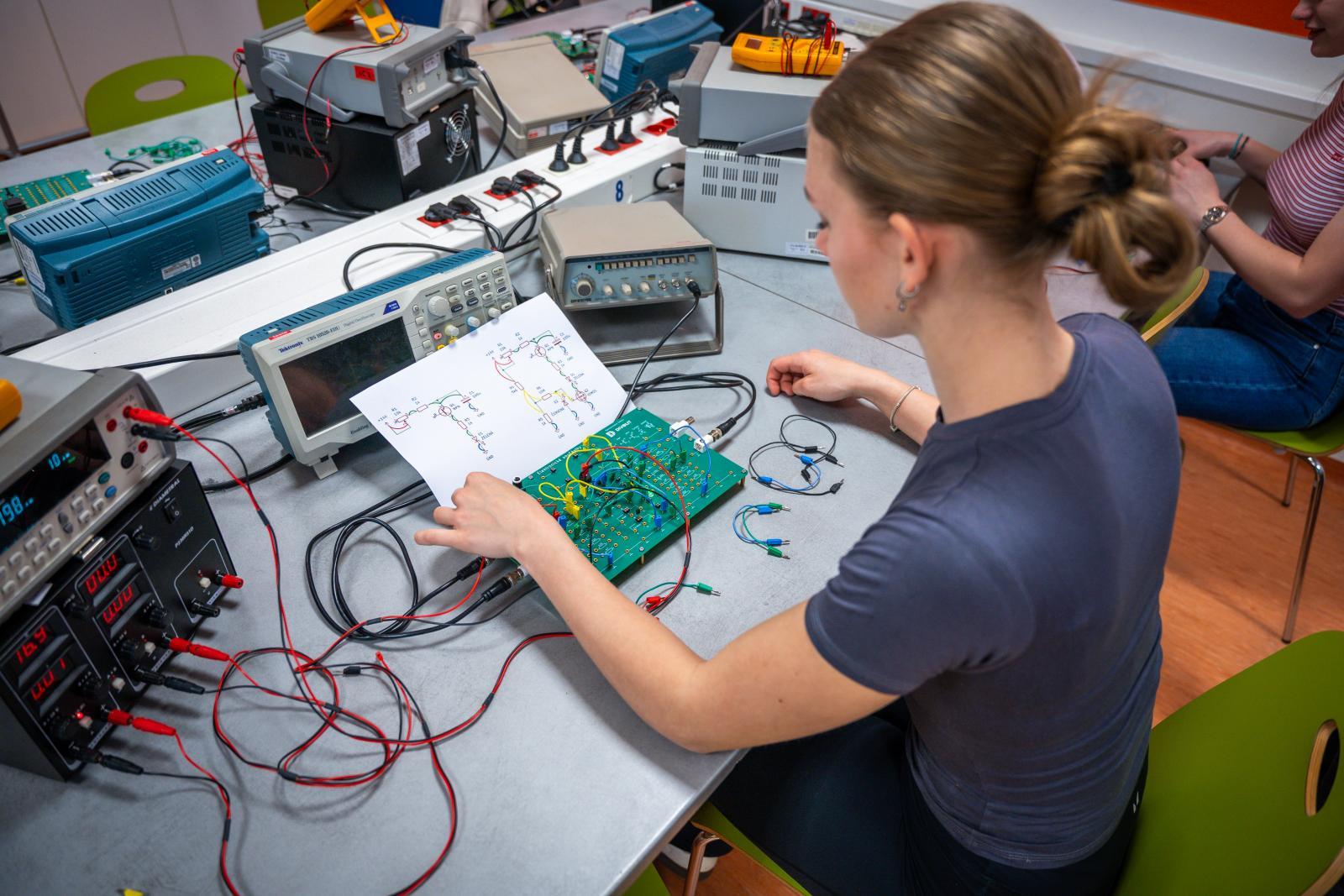
Technical fields are not just for men. Brno University of Technology is opening its doors to young women who want to participate in the development of cutting-edge chips and semiconductors – key technologies of the future. The Faculty of Electrical Engineering and Communication (FEEC) offers female students the opportunity to pursue a career in a field with significant potential – in a supportive environment, with support during their studies and inspiring female role models. Despite this, technical disciplines still face a shortage of women who are valuable assets in scientific teams.
In spring 2025, the Czech Semiconductor Centre was opened, whose coordinator and deputy director is Jana Drbohlavová. Her position proves that there is definitely a place for women in electrical engineering. Nevertheless, she meets with their little interest in this field. “This is often due to the fear of female students of the difficulty of the main technical subjects. Girls have little confidence, and it was a challenge for me at the time. Nevertheless, there are no tricky issues, many classmates are helpful to the students, as are many teachers,” says Drbohlavová of her experience. Her words are confirmed by Jiří Háze, head of the Institute of Microelectronics at the FEEC BUT: “We know from our statistics that the vast majority of our female students complete their technical studies, many with honours.” This proves that electrical engineering is suitable for women and they can excel in it.
A place for women in microelectronics? There definitely is
 Women are a welcome group in semiconductor research and industry. “Personally, I think precision – a quality so intrinsic to women – is important when working with semiconductors or designing chips. However, the necessary knowledge remains key, regardless of gender,” says Háze. There is currently a shortage of 3 000 semiconductor specialists in the Czech Republic and it is important to increase the number of students in related technical fields, whether they are women or men.
According to Háze is important not only from the point of view of gender equality, but especially for practice. “Women and men complement each other in technical research. Often, we get a result together sooner than if only men were working on it. Women’s perspectives and solutions to problems are undoubtedly appropriate,” he says. Yet female students account for only 12% of all students studying engineering at BUT. And only 2.59% of applicants for the two new degree programmes open in the 2025/2026 academic year, focusing on the study of semiconductor and chip design and manufacturing, are girls.
Girls are often inspired to study engineering by their surroundings
 According to experts from the BUT, there are several factors that increase girls’ interest in technical studies. These include, for example, interesting mathematics or physics teaching in secondary schools or role models in the family. For Jana Drbohlavová, the inspiration came from her electrician mother, who encouraged her daughter’s love of chemistry. For PhD student Veronika Junasová from the FEEC BUT, it was her uncle who repaired small electronics. She herself is involved in outreach activities for girls such as this year’s togetHER in tech popularisation day at the BUT. “Maths and physics are not scary subjects only for people with logical thinking. I personally know that logic can be discovered even if you don’t think you have it,” Junas said.
Microelectronics offers room for development and balance
Today’s microelectronics offers both a great market and good financial reward, as well as a variety of different subfields, whether it is chip manufacturing technology, research into the technology or its application in practice. Chip and semiconductor experts are in demand by large corporate firms as well as smaller companies focused on hardware and firmware design. You can start working while studying. “It is not a problem for students to find a job in the field after their bachelor’s degree and to gain experience for the practice,” Veronika Junasová describes her experience.
Women’s representation in technical fields improving, but not yet ideal
 Microelectronics, which deals with semiconductors and chips, is not the only technically oriented sector where professionals face a lack of women. This is also evident in nuclear physics and nuclear engineering, electron optics, cybernetics and robotics, and information technology. The Czech non-profit organisation Czechitas focuses on the gender gap in the latter field.
“In the 10 years that Czechitas has been operating, the share of women in ICT has increased. Today we are at 12 percent in employment and 17 percent in ICT studies, whereas before it was less than 10 percent. It may not seem like a big leap, but in a world of data trends, it’s a move in the right direction, especially when you consider the systematic barriers women face,” says Monika Ptáčníková, co-founder of Czechitas, describing the changes. The organisation helps to organise retraining courses, mentoring programmes to support female talent or form mixed teams in IT. At the same time, its representatives actively communicate with the Czech government to bring necessary changes to the system. “Today, most partners understand that women bring concrete value – resilience in teams, ability to collaborate, higher performance and innovation, and other social and economic benefits,” says Ptáčníková.
Source: FEEC BUT
Photos: Václav Koníček